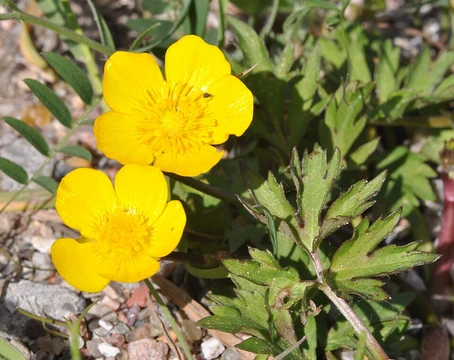
Violet
A spectral color and a genus of flowering plants.

Violet is a term with multiple meanings, primarily referring to a spectral color with wavelengths shorter than blue, as well as several plants named violet, particularly the genus Viola. The term also appears in various contexts including places, media, entertainment, people, ships, and other uses.
- field
- Color, botany, geography, media, entertainment, people, ships
- known_for
- Spectral color; genus of flowering plants; numerous places, films, albums, songs, and other cultural references
Lore & Background
Violet is a spectral color with wavelengths shorter than blue. It is also the name of several plants, particularly those in the genus Viola, a group of flowering plants. The term appears in many place names, including Violet, Louisiana; Violet, Missouri; Violet, Texas; Violet, West Virginia; Violet, Ontario, Canada; and Violet Town, Victoria, Australia. It also appears as album titles by The Birthday Massacre, Closterkeller, Pentagon, and L.S. Dunes, and as song titles by Hole, Seal, Pentagon, Joe Morris, Daniel Caesar, and Ninomae Ina'nis. Other uses include an opera by Roger Scruton, a musical by Jeanine Tesori, a computer game, a fairy tale by Giambattista Basile, and a Pokémon game.
Reader's Guide
The term 'violet' holds significance across multiple domains. As a color, it is a fundamental spectral hue. In botany, it denotes a common genus of flowering plants. Its widespread use in place names, particularly in the United States and other countries, reflects its cultural resonance. In media and entertainment, the numerous films, albums, songs, and other works titled 'Violet' demonstrate its enduring appeal as a title and theme. Additionally, it is used as a given name, a codename for characters in Persona 5 and DC Comics, and the name of athletic teams at New York University. This breadth of usage illustrates how a single word can connect color, nature, geography, art, and history.
Did You Know?
- Violet is a spectral color with wavelengths shorter than blue.
- Several plants named violet belong to the genus Viola.
- There are places named Violet in Louisiana, Missouri, Texas, West Virginia, and Ontario, Canada.
- Eight ships of the Royal Navy have been named HMS Violet.
Frequently Asked Questions
What is Violet in botanical terms?
Violet is the common name for the genus Viola, a large group of herbaceous flowering plants in the family Violaceae. They are recognized by their small, often asymmetrical blooms and heart-shaped leaves.
How many species are in the genus Viola?
The genus Viola contains roughly 500 to 700 described species, making it one of the more diverse genera of temperate flowering plants. New species are still being identified in mountain and alpine regions.
What do Violet flowers look like?
A typical Violet blossom has five petals arranged in a slightly irregular, bilateral shape, with a small nectar spur extending from the back. Colors range from deep purple and blue to white, yellow, and pink, often with darker veining on the lower petals.
Where do Violet plants naturally grow?
Members of the genus Viola are native to cool, moist habitats across North America, Europe, and parts of Asia, including meadows, woodland edges, and alpine slopes. They generally prefer partial shade and well-drained, slightly acidic soil.
Why is Violet considered a classic garden plant?
Violet has been cultivated for ornamental purposes since antiquity, valued for its early spring bloom, subtle fragrance, and compact habit. It also carries deep cultural symbolism, historically linked to modesty, faithfulness, and remembrance in European and Asian traditions.
More in Flowering Plants 1-15
Spotted an error? Know more?
This is a living reference — every entry is fact-audited, and reader corrections feed straight into our audit queue. Suggest an edit · See this site's audit record