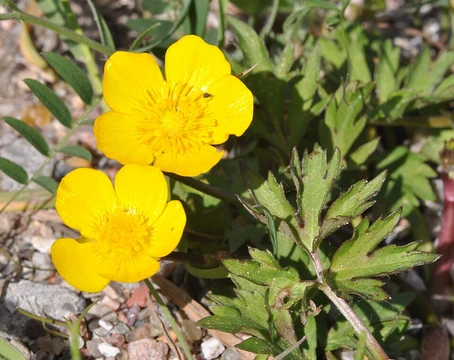
Impatiens
A diverse genus of flowering plants with explosive seed capsules.

Impatiens is a genus of more than 1,000 species of flowering plants in the family Balsaminaceae, widely distributed throughout the Northern Hemisphere and the tropics. Known for their explosive seed dispersal and diverse flower forms, they are commonly called jewelweed, touch-me-not, or busy lizzie, and have significance in horticulture, ecology, and traditional medicine.
- species_count
- over 1,000
- family
- Balsaminaceae
- common_names
- impatiens, jewelweed, touch-me-not, snapweed, patience, busy lizzie, balsam
- distribution
- Africa, Eurasia, North America, with isolated species in Central America
- flower_type
- zygomorphic, protandric, often with a nectar spur
- seed_dispersal
- explosive dehiscence, sending seeds up to several meters
- notable_species
- Impatiens walleriana, Impatiens glandulifera, Impatiens capensis
Lore & Background
Most Impatiens species are herbaceous annuals or perennials with succulent stems, ranging from five centimeters to 2.5 meters in height. Their leaves are entire, often dentate or sinuate, and may have a silvery sheen when held underwater due to trapped air bubbles. The flowers are zygomorphic and protandric, with three sepals (one forming a nectar spur) and five petals, the lateral pairs fused. The five stamens fuse into a cap that falls off after the male phase, reducing self-pollination. The genus name Impatiens, Latin for 'impatient,' and the common name 'touch-me-not' refer to the explosive dehiscence of the seed capsules, which burst and send seeds several meters away.
Reader's Guide
Impatiens species are ecologically important as understory plants in forests, particularly along streams and forest edges, and some are invasive weeds, such as Impatiens glandulifera, which displaces native plants and exacerbates riverbank erosion. The genus is notable for its diverse flower architectures, which have evolved to attract specific pollinators including bees, butterflies, moths, flies, and sunbirds. Many species are self-compatible and can produce cleistogamous flowers under adverse conditions. Impatiens has been used in traditional medicine, particularly North American species for treating insect bites, stings, and poison ivy rashes, though studies on efficacy show conflicting results. The genus also contains 2-methoxy-1,4-naphthoquinone, an anti-inflammatory compound used in some formulations of Preparation H. The genus serves as a model in plant evolutionary developmental biology due to its varied flower shapes.
Did You Know?
- The name 'touch-me-not' refers to the explosive seed capsules that burst and send seeds several meters away.
- Impatiens glandulifera, known as Himalayan balsam, is an invasive weed in Europe that displaces smaller plants and increases riverbank erosion.
- North American jewelweeds have been used as herbal remedies for bee stings, insect bites, and poison ivy rashes, though study results are conflicting.
Naming & Taxonomic Identity
Impatiens stands as one of the larger genera in the flowering plant world, encompassing more than a thousand distinct species that span the Northern Hemisphere and tropical regions. Alongside the single-species genus Hydrocera, it constitutes the entire family Balsaminaceae, a classification that underscores how much botanical diversity can be packed into a relatively compact taxonomic grouping. The genus carries a remarkable variety of common names across cultures. In North America, people refer to these plants as impatiens, jewelweed, touch-me-not, snapweed, or patience, with jewelweed typically reserved for Nearctic species and balsam applied to tropical ones. In the British Isles, the names impatiens and busy lizzie dominate, particularly for the countless cultivars descended from Impatiens walleriana. The striking Himalayan species Impatiens glandulifera earns the nickname policeman's helmet in the UK. The Latin genus name itself, meaning impatient, captures the dramatic explosive dehiscence of the seed capsules, a trait that also inspired the evocative common name touch-me-not.
Floral Architecture & Reproductive Ingenuity
Impatiens flowers display a fascinating reproductive strategy built around protandry, in which each bloom transitions from a male phase to a female one as it ages. The zygomorphic corolla is composed of five petals whose lateral pairs are fused, while the calyx bears five free sepals. In most species, one pair of sepals is strongly reduced, and the remaining unpaired sepal elongates into a nectar-filled spur that dangles beneath the flower. During the male phase, five fused stamens form a protective cap over the ovary. Once this cap detaches, the stigma becomes receptive, a temporal separation that minimizes self-pollination. The genus exhibits three principal flower architectures: a sacculate-spurred two-lipped form, a filiform-spurred flat form, and the spur-less Madagascan type. Pollinator communities range from bees and bumblebees to butterflies, moths, flies, and sunbirds, with a few species capable of cleistogamous self-seeding when external pollinators are scarce.
Range, Naturalization & Invasive Threats
Native to Africa, Eurasia, and North America, Impatiens species thrive predominantly in the misty mountain forests of Madagascar, the Himalayas, the Western Ghats of southwest India, and southeast Asia, often lining streams or forest edges. Two isolated species, I. turrialbana and I. mexicana, persist in southern Mexico and Costa Rica. In Europe, the sole native representative is I. noli-tangere, found in Central and Northern regions. Human activity has reshaped the genus's European footprint considerably. In the nineteenth and twentieth centuries, the North American orange jewelweed (I. capensis) was introduced to England, France, the Netherlands, Poland, Sweden, and Finland. Small balsam (I. parviflora) from southern Central Asia has naturalized even more widely. The most consequential invader is Himalayan balsam (I. glandulifera), whose dense growth shades out smaller plants, dominates riparian zones along polluted and nitrogen-rich waterways, and, because of its shallow root system, leaves riverbanks vulnerable to erosion, compounding ecosystem degradation.
Ecological Interactions & Evolutionary Significance
Beyond their ornamental appeal, Impatiens species occupy a rich web of ecological relationships. Their foliage serves as larval food for Lepidoptera such as the dot moth (Melanchra persicariae) and is also consumed by the Japanese beetle (Popillia japonica). The leaves are toxic to birds like the budgerigar, though that same bird will readily eat the flowers. Bumblebees and the common spotted flat (Celaenorrhinus leucocera) visit the blooms, while the parasitic vine European dodder (Cuscuta europaea) exploits the plants as hosts. From a scientific standpoint, the genus has become a valued model organism in plant evolutionary developmental biology, owing to the stark diversity of its flower shapes and the ease with which many species are cultivated. Impatiens also sits phylogenetically close to the carnivorous plant families Roridulaceae and Sarraceniaceae. Notably, peculiar stalked glands on balsam sepals secrete mucus, structures that may be homologous to the prey-capturing organs found in those carnivorous relatives, hinting at a shared evolutionary heritage.
Frequently Asked Questions
What is Impatiens?
Impatiens is a large genus of flowering plants in the family Balsaminaceae, containing well over a thousand described species. Its members are recognized by bilaterally symmetric, often spurred flowers and a protandric pollination strategy that separates the timing of male and female function.
What are the common names people use for Impatiens?
You'll hear them called jewelweed, touch-me-not, busy lizzie, snapweed, patience, or balsam depending on the region and species. The nickname 'touch-me-not' comes from the seed capsule's sensitivity to physical contact, which triggers it to split open.
How does Impatiens disperse its seeds?
The genus is famous for explosive dehiscence: once the capsule fully matures, it ruptures with a snap and hurls its seeds several meters from the parent plant. This dramatic ejection mechanism is one of the most instantly recognizable traits of the group.
Where are Impatiens species found in the wild?
The genus has a broad distribution spanning Africa, Eurasia, and North America, with a handful of isolated species in Central America. Most species favor moist, temperate-to-tropical habitats, particularly in the Northern Hemisphere.
Why is Impatiens considered important beyond just looking pretty?
In addition to their long-standing role as ornamental garden plants, many species provide critical nectar for pollinators and have been used in traditional medicine across several cultures. Their ecological versatility and diverse flower architecture make them a key group in both horticulture and native-plant conservation.
More in Flowering Plants 1-15
Spotted an error? Know more?
This is a living reference — every entry is fact-audited, and reader corrections feed straight into our audit queue. Suggest an edit · See this site's audit record