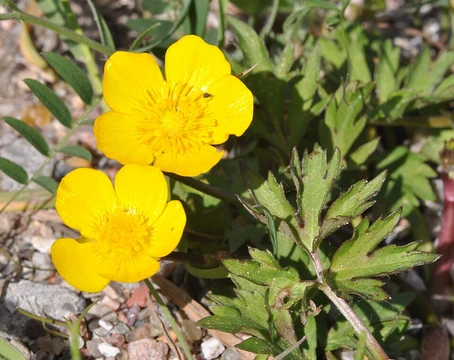
Helianthus
A genus of sunflowers native to North America, widely cultivated.

Helianthus is a genus comprising around 50 species of annual and perennial flowering plants in the daisy family Asteraceae, commonly known as sunflowers. Native to North America, the best-known species is the common sunflower (Helianthus annuus), which is cultivated in temperate and some tropical regions as a food crop for humans, cattle, and poultry, and as an ornamental plant. The genus is also notable for the Jerusalem artichoke (H. tuberosus), an edible tuber-producing species.
- common_name
- Sunflower
- scientific_name
- Helianthus
- family
- Asteraceae
- native_range
- North America
- number_of_species
- Around 50
- best_known_species
- Helianthus annuus (common sunflower)
- national_flower_of
- Ukraine
Lore & Background
Several perennial Helianthus species are grown in gardens but can spread rapidly and become aggressive. The common sunflower is the national flower of Ukraine, cultivated there for several centuries. Helianthus species are used as food plants by the larvae of many lepidopterans and attract beneficial insects, including pollinators and parasitoids that reduce pest populations in nearby crops.
Reader's Guide
Helianthus holds significance as a genus of flowering plants that includes the common sunflower, a globally important food crop for humans, cattle, and poultry, as well as an ornamental plant. The genus is native to North America and comprises around 50 species, both annual and perennial. The common sunflower is the national flower of Ukraine, reflecting its long cultivation there. The genus is also notable for the Jerusalem artichoke (H. tuberosus), which produces edible tubers. Several perennial species are grown in gardens but can become invasive, while one species, Helianthus verticillatus, is listed as endangered due to industrial forestry. The heliotropic behavior of young sunflower heads—tracking the Sun from east to west during the day and reorienting at night—is a distinctive biological phenomenon driven by stem growth rates and circadian rhythms. This movement attracts pollinators and increases growth metabolism. The genus also serves as a food source for lepidopteran larvae and attracts beneficial insects that help control crop pests. The Land Institute and other breeding programs are exploring perennial sunflower species as potential seed crops. Overall, Helianthus combines agricultural, ornamental, ecological, and scientific importance.
Did You Know?
- The common sunflower (Helianthus annuus) is the national flower of Ukraine, cultivated there for several centuries.
- Before blooming, sunflower heads track the Sun from east to west during the day and reorient to face east at night.
- The genus name Helianthus comes from Greek words for 'sun' and 'flower'.
Botanical Architecture and Species Diversity
Helianthus encompasses roughly fifty species of annual and perennial flowering plants belonging to the daisy family, Asteraceae, all native to North America. While the common sunflower (H. annuus) is the most widely recognized, the genus displays remarkable structural variety. What appears to be a single large bloom is actually a composite disc composed of numerous tiny individual flowers, an arrangement that maximizes pollinator attraction. The outer ring typically bears bright yellow ray florets—technically sterile—surrounding a center of yellow or maroon disc florets. Notably, all red-rayed ornamental cultivars trace back to a single original mutant, and branching varieties in orange, red, and purple also exist. Leaves are petiolate, dentate, and often sticky, with lower foliage arranged oppositely in ovate or heart-shaped forms. Stems are rough and hairy, tending to branch in wild specimens but remaining unbranched in domesticated lines. Technically, the genus is set apart by a pappus of two caducous awn-like scales on disc flowers, a multicellular appendage at the style apex visible only under magnification, and florets arranged in a natural spiral. One species, H. radula, dispenses with ray flowers entirely, while several perennials develop basal rosettes of large leaves with reduced foliage on flowering stems.
Heliotropism: The Sun-Tracking Dance
Before a sunflower reaches full bloom, its head performs a daily choreography known as heliotropism. During daylight, the flower tilts upward and tracks the sun across the sky. At night it reorients to face east, anticipating sunrise, with the return occurring between three and six in the morning. Leaves follow roughly an hour behind. Once the plant reaches anthesis, tracking ceases and the mature bloom remains fixed facing east, allowing the rising sun to warm it early. This distinction has historically confused researchers, many of whom studied already-bloomed specimens and concluded the plants were not truly heliotropic. The mechanism differs fundamentally from leaf movement: because flowers lack pulvini, the bending is driven by differential stem growth. During the day, growth hormones accumulate on the east side of the stem, gradually pushing the head westward in sync with the sun's arc. At night, the west side grows faster, swinging the head back east. The movement is endogenous—it persists on overcast days—but halts during prolonged rain or in greenhouses with static light. Sunflowers even discriminate by wavelength, bending toward blue light but ignoring red. Ultimately, circadian rhythms and asymmetric stem growth work in concert to enhance pollinator attraction and growth.
Cultivation, Ecology, and Conservation
Helianthus species serve a wide range of practical purposes. The common sunflower and the Jerusalem artichoke (H. tuberosus) are cultivated across temperate and some tropical regions as food crops for humans, cattle, and poultry, as well as ornamental garden plants. H. annuus typically grows through summer into early fall, with peak development in mid-summer. In Ukraine, the common sunflower holds the status of national flower, a role it has occupied for several centuries. Ecologically, sunflowers support diverse food webs, serving as larval food plants for numerous lepidopteran species. However, cultivation is not without complications. Several perennial Helianthus species, while valued in gardens, have a tendency to spread rapidly and can become aggressive invaders. On the conservation front, the whorled sunflower (H. Fish and Wildlife Service issued a final rule under the Endangered Species Act. This species, which reaches about 1.8 metres in height, is primarily found in woodlands adjacent to creeks and moist, prairie-like areas in Alabama, Georgia, and Tennessee. Its principal threats are industrial forestry operations and the expansion of pine plantations, which degrade the specific habitats it requires.
Growth, Development, and Evolutionary Biology
The development of a Helianthus plant is governed strictly by its genetic makeup and background. The season of planting significantly influences its trajectory, with growth typically peaking in mid-summer and continuing into early fall. Development is classified through a series of vegetative and reproductive stages, identifiable by examining the head structure—whether a single head, a branched head, or the main branch configuration. At the macroevolutionary level, the Helianthus genus has been shaped by multiple biotic and abiotic factors influencing various aspects of floral morphology. The composite flower head, with its florets arranged in a natural spiral, represents an adaptation to maximize pollinator attraction. The sterile ray florets surrounding fertile disc florets create a larger visual target, while heliotropic tracking of young heads further enhances visibility to visiting insects. The genus also demonstrates variability among its perennial members. Some species concentrate large leaves in a basal rosette, producing a flowering stem with reduced foliage. Most perennials bear entirely yellow disc flowers, though a few develop reddish lobes. The macroevolutionary trajectory of Helianthus thus reflects a complex interplay of selective pressures, from pollinator ecology to habitat conditions, driving the diversity of form observed across the fifty species in the genus.
Frequently Asked Questions
What is Helianthus?
Helianthus is a genus of annual and perennial flowering plants belonging to the daisy family, Asteraceae. It is the botanical group that encompasses what most people simply call sunflowers.
How many species are in the Helianthus genus?
The genus contains roughly fifty species in total, spanning both short-lived annuals and long-lived perennials. They vary in size, bloom time, and habitat across their native range.
Where are Helianthus plants native to?
Every species in this genus originates from North America. The most popular varieties have since been cultivated in temperate and some tropical regions around the globe.
What is the most well-known Helianthus species?
The common sunflower, Helianthus annuus, is by far the most recognized member of the genus. It is grown worldwide as a food crop for people, cattle, and poultry, as well as a popular ornamental garden plant.
What is the Jerusalem artichoke's connection to Helianthus?
The Jerusalem artichoke is the species Helianthus tuberosus, distinguished by its edible underground tubers. It stands out among sunflowers as a species prized primarily for its root rather than its seeds or blossoms.
More in Flowering Plants 1-15
Spotted an error? Know more?
This is a living reference — every entry is fact-audited, and reader corrections feed straight into our audit queue. Suggest an edit · See this site's audit record