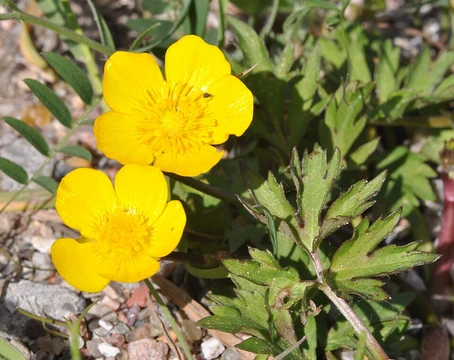
Rose
A diverse genus of flowering plants with cultural and ornamental significance.

A rose is a woody perennial flowering plant of the genus Rosa, in the family Rosaceae, or the flower it bears. There are over three hundred species and tens of thousands of cultivars, ranging from trailing shrubs to climbers up to 7 meters in height. Roses have acquired cultural significance in many societies and are widely grown for their beauty and fragrance.
- Genus
- Rosa
- Family
- Rosaceae
- Native range
- Mostly Asia, also Europe, North America, Northwest Africa
- Flower colors
- White, pink, red, orange, yellow
- Notable feature
- Sharp prickles (not thorns) on stems
Lore & Background
The name rose comes from Latin rosa, possibly borrowed from Oscan, Greek, and Old Persian. The oldest remains of roses are from the Late Eocene Florissant Formation of Colorado, and roses were present in Europe by the early Oligocene. Today's garden roses originate from 18th-century China, via Rosa chinensis. The genus Rosa is divided into four subgenera: Hulthemia, Hesperrhodos, Platyrhodon, and Rosa (the type subgenus), with the latter containing 11 sections such as Banksianae, Caninae, and Chinensis.
Reader's Guide
They are also used for commercial perfumery and cut flower crops. The flowers of most species have five petals, and the fruit is a berry-like hip rich in vitamin C in some species. Roses are insect-pollinated, and many domestic cultivars do not produce hips due to tightly petalled flowers. Prickles on stems are technically outgrowths of the epidermis, not true thorns. A study of the rose genome indicated positive selection on genes related to DNA damage repair and stress adaptation during domestication.
Did You Know?
- The sharp growths on rose stems are technically prickles, not thorns.
- Rose hips of some species, like the dog rose, are among the richest plant sources of vitamin C.
- The oldest rose remains are from the Late Eocene Florissant Formation of Colorado.
- Blocking the LOG gene in roses reduces prickles into tiny buds.
Biblical Origins and the Translation Puzzle
The phrase now familiar in English as 'Rose of Sharon' first surfaces in the Hebrew Tanakh, in the Song of Songs, where the beloved calls herself a flower of the Sharon valley. The original expression, ḥăḇaṣṣeleṯ haššārōn, has generated centuries of interpretive disagreement. The King James Version rendered it as 'rose of Sharon,' yet the Greek Septuagint called it a flower of the field, the Latin Vulgate used flos campi, and the Wycliffe translation likewise settled on 'flower of the field.' The same Hebrew word appears once more in Isaiah, where the desert blooms like this flower, and there the translations scatter even wider—lily in the Septuagint, Vulgate, and Wycliffe; jonquil in the Jerusalem Bible; crocus in the Revised Standard Version. The New Revised Standard Version's committee annotated the Song of Solomon passage as a mistranslation of a broader Hebrew term for crocus. Etymologists have tentatively linked the root to Hebrew words meaning 'bulb' and either 'pungent' or 'splendid,' while more recent multilingual scholarship has proposed reading the phrase simply as 'a budding bulb,' stripping away the floral specificity that centuries of translation had layered on top.
The Unresolved Botanical Identity
Despite its evocative name, the 'Rose of Sharon' does not refer to any species of rose in any scholarly interpretation. The identity of the plant behind the biblical phrase remains genuinely unresolved, and the question has been cited as a textbook example of how imprecise common names can breed confusion across disciplines. Scholars and botanists have advanced a wide range of candidates. A crocus growing among brambles in the coastal plain of Sharon is suggested by Harper's Bible Dictionary and the New Oxford Annotated Bible. A bright red, tulip-like flower thriving in the hills of Sharon is another proposal, with specific species such as Tulipa agenensis and Tulipa montana named by a few botanists. The Madonna lily, Lilium candidum, has been offered by others, possibly in reference to the lilies of the valley mentioned in the same verse of Song of Songs. Narcissus also appears on the list. One particularly intriguing candidate is Pancratium maritimum, a coastal bloom that flowers in late summer just above the high-tide mark; its modern Hebrew name, ḥăḇaṣṣeleṯ haḥōf, preserves the biblical root, and some scholars identify it with the Song of Songs flower, though not all accept the connection.
Modern Horticultural Applications Across Cultures
Outside the Levant, the name 'rose of Sharon' has been adopted by several entirely unrelated flowering plants, none of which is likely to have been the species referenced in the Bible. In British English, the name most commonly refers to Hypericum calycinum, an evergreen flowering shrub native to southeast Europe and southwest Asia. Across the Atlantic, North American gardeners typically use the same name for Hibiscus syriacus, a deciduous shrub originating in east Asia that also carries the Korean name Mugunghwa and the alternate English name Althaea, and which holds the distinction of being South Korea's national flower. In Malaysia, the designation attaches to Hibiscus rosa-sinensis, specifically the cultivar known as 'Vulcan,' which serves as that nation's national flower. The sheer variety of plants sharing this single English label—spanning different continents, growth habits, and taxonomic families—illustrates precisely the kind of nomenclatural ambiguity that makes common plant names a persistent source of confusion for botanists, translators, and the general public alike.
Cultural Echoes in Literature and Media
Beyond botany and scripture, the phrase 'Rose of Sharon' has left a distinctive mark on personal naming conventions and popular culture. Spoken as a single flowing word, 'Rosasharn,' it occasionally appears as a given name, most famously in John Steinbeck's novel The Grapes of Wrath, where the character Rose of Sharon Joad brings the biblical phrase into the narrative. The name has also crossed into the world of video games: in Fallout: New Vegas, a character named Rose of Sharon Cassidy can serve as a potential companion for the Courier, bringing the biblical resonance into a post-apocalyptic sci-fi setting. The name's varied colloquial application across gardens, novels, and digital worlds has itself become a useful illustration of how a single poetic phrase, once detached from its original context, can multiply into dozens of unrelated referents. In this sense, the 'Rose of Sharon' endures less as a fixed botanical or theological term than as a flexible cultural symbol, its meaning shaped by every new speaker who borrows it.
Frequently Asked Questions
What is a rose?
A rose is a woody perennial flowering plant belonging to the genus Rosa within the family Rosaceae. Depending on the variety, it can grow as a low trailing shrub or as a climbing vine reaching up to seven meters tall.
How many kinds of roses exist?
The genus Rosa encompasses over three hundred distinct species, and human breeding has added tens of thousands of cultivated varieties on top of that. This makes roses one of the most diverse ornamental plant groups in horticulture.
Do roses actually have thorns?
Strictly speaking, roses bear sharp prickles along their stems rather than true thorns. True thorns are modified branches, whereas rose prickles are outward projections of the stem tissue itself.
Where are roses native to?
Roses are predominantly native to Asia, though wild populations also occur in parts of Europe, North America, and Northwest Africa. This broad native range has allowed them to adapt to a wide variety of climates.
What colors do rose blooms come in?
Rose flowers appear in white, pink, red, orange, and yellow. Beyond their visual appeal, they are also celebrated for their distinctive fragrance, which has given them deep cultural significance across many societies.
More in Flowering Plants 1-15
Spotted an error? Know more?
This is a living reference — every entry is fact-audited, and reader corrections feed straight into our audit queue. Suggest an edit · See this site's audit record