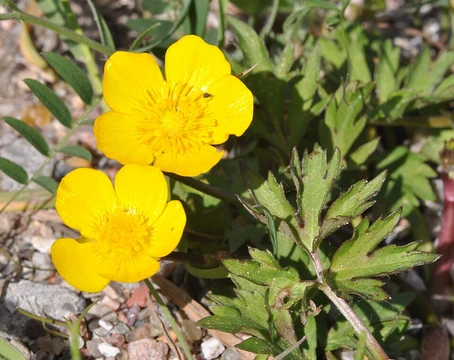
Iris (plant)
A genus of showy flowers, widely cultivated and used in statistical analysis.

- scientific_name
- Iris
- family
- Iridaceae
- common_names
- Iris, flags, junos
- native_range
- Temperate Northern Hemisphere (Europe, Asia, North America)
- flower_type
- Epigynous, with three falls and three standards
- pollination_mechanism
- Insect-mediated, with specialized landing platform and stigma placement
Lore & Background
The genus Iris takes its name from the Greek word for 'rainbow,' also the name of the Greek goddess of the rainbow, Iris. Some authors state that the name refers to the wide variety of flower colors found among the many species. Irises are perennial plants, growing from creeping rhizomes or, in drier climates, from bulbs. They have long, erect flowering stems and sword-shaped leaves. The inflorescences are fan-shaped, with symmetrical six-lobed flowers. The three sepals, called 'falls,' often have a beard of fuzzy hairs that guides pollinators to nectar. The three petals, called 'standards,' stand upright. The flower structure is adapted to ensure cross-pollination: an insect entering a flower deposits pollen on the stigma, but when backing out, it contacts only the non-receptive lower face of the stigma, preventing self-pollination.
Reader's Guide
Iris is significant both horticulturally and scientifically. As a popular garden flower, it is extensively grown in home and botanical gardens worldwide, with notable collections such as the Presby Memorial Iris Gardens in New Jersey and the Giardino dell'Iris in Florence, Italy. The British Iris Society promotes the plant in the United Kingdom, and the American Iris Society serves as the International Cultivar Registration Authority. The genus also illustrates introgressive hybridization, a concept first coined to describe the pattern of interspecific hybridization followed by backcrossing common in Iris. Modern classifications generally recognize six subgenera, though some authors have proposed splitting certain groups into separate genera, a point of ongoing taxonomic debate.
Did You Know?
- The genus name Iris comes from the Greek word for 'rainbow,' also the name of the Greek goddess of the rainbow.
- The flower's structure ensures that an insect bearing pollen from another flower deposits it on the stigma upon entering, but does not self-pollinate when backing out.
Flower Architecture & the Pollination Dance
The iris flower stands as a remarkable example of co-evolution between flowering plants and pollinating insects. The inflorescence fans out to present one or more symmetrical, six-lobed blooms on a pedicel or peduncel. Three outer sepals, commonly called "falls," spread outward or droop downward, expanding from a narrow base known as the claw into a broader blade that may be adorned with veining, lines, or dots. In bearded species, a fuzzy row of hairs at the base of each fall petal provides a landing platform and guides insects toward nectar. Three upright petals, termed "standards," rise behind the sepal bases, and in many species the two sets differ markedly in appearance. All six lobes unite at their base into a floral tube positioned above the ovary, making the flower epigynous with an inferior ovary. The three styles split into petaloid branches near the tip. The pollination sequence is elegantly choreographed: an insect probing for nectar first touches the perianth, then the three stigmatic surfaces, and only afterward encounters the pollen-bearing surface beneath the style arms. When it backs out, it contacts only the non-receptive lower face of the stigma, ensuring cross-pollination rather than self-pollination.
Taxonomic History & the Debate Over Boundaries
The classification of Iris has been a subject of ongoing debate among botanists. Rodionenko controversially split several bulbous subgenera into separate genera—Xiphion, Juno, and Iridodictyum—though this was not widely adopted. The six subgenera—bearded rhizomatous, beardless rhizomatous, and four bulbous groups—reflect fundamentally different growth strategies and geographic ranges, with five restricted to the Old World and only Limniris enjoying a Holarctic spread. The section Limneris within subgenus Limniris was further divided into sixteen series, underscoring the extraordinary internal diversity of this single genus.
Growth Forms, Morphology & Evolutionary Fluidity
Irises are perennials that adapt their growth strategy to climate. In moister environments, rhizomatous species spread through creeping underground stems, producing dense clumps of three to ten basal, sword-shaped leaves. In drier regions, bulbous species store energy in underground bulbs, from which two to ten narrow leaves emerge. The flowering stems are long and erect, varying in structure: some are simple while others branch; some are solid while others are hollow; cross-sections range from flattened to circular. The fruit is a capsule that splits into three parts, releasing numerous seeds. In certain species like Iris stolonifera, the seeds carry a thick white aril, a fleshy appendage that likely aids in dispersal. The genus also absorbs several formerly independent lineages: Belamcanda (the blackberry lily), Hermodactylus (the snake's head iris), and Pardanthopsis (the vesper iris) are now recognized as monotypic groups within Iris rather than separate genera, reflecting a broader understanding of their evolutionary relationships. The concept of introgressive hybridization—interspecific hybridization followed by backcrossing to the parentals—was first coined to describe this very pattern within the genus, highlighting how freely these species exchange genetic material.
Nomenclature, Common Names & a Legacy Beyond Botany
The name Iris derives from the Greek word for rainbow, also the name of the Greek goddess associated with rainbows, and many authors connect the name to the extraordinary diversity of flower colors across the genus. Beyond the scientific name, the common name iris is applied broadly to all species in the genus and even to some closely related genera. In horticultural circles, certain species are called flags, while the subgenus Scorpiris is widely known as junos. The genus has also left a mark far beyond botany. This dataset became one of the most widely referenced in statistics and machine learning, ensuring that the humble garden flower would be encountered in fields as diverse as computer science and data science, long after its botanical significance was established. As a popular garden flower, iris cultivars continue to delight horticulturists worldwide, bridging the gap between ornamental beauty and scientific inquiry.
Frequently Asked Questions
What is Iris (plant)?
Iris is a genus of showy flowering plants in the family Iridaceae, often called flags or junos by gardeners. It is one of the most widely cultivated ornamental flower groups worldwide.
What does an Iris bloom look like?
Each flower is epigynous and displays three drooping outer petals known as falls alongside three upright inner petals called standards. This six-part arrangement gives the bloom its characteristic flag-like silhouette.
Where is Iris native to?
The genus is indigenous to temperate zones across the Northern Hemisphere, including parts of Europe, Asia, and North America. It has since been planted and naturalized in many other regions.
How does Iris get pollinated?
Iris depends on insect-mediated pollination, providing a dedicated landing platform that guides visiting insects toward the reproductive parts. The stigma is positioned so that a pollinator's body brushes against it during the visit, ensuring effective pollen transfer.
Why is Iris notable beyond just being a pretty flower?
In addition to its ornamental appeal, Iris has become a staple example in statistical analysis, frequently used as a classic dataset for classification and machine-learning exercises. Its structurally distinct blooms also make it a favorite for gardens and cut-flower arrangements.
More in Flowering Plants 1-15
Spotted an error? Know more?
This is a living reference — every entry is fact-audited, and reader corrections feed straight into our audit queue. Suggest an edit · See this site's audit record