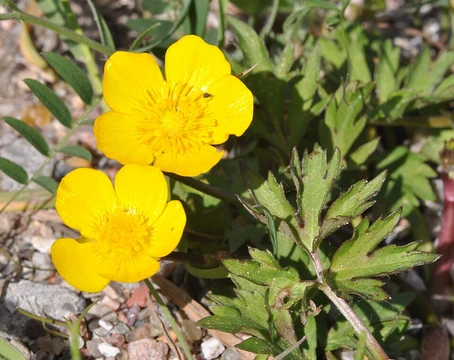
Sunflower
A domesticated annual forb grown for seeds and oil.

The common sunflower (Helianthus annuus) is a large annual forb in the daisy family Asteraceae. Domesticated for its edible seeds, it is grown globally for oilseed and confectionary purposes, and also as an ornamental plant. Its seeds are a major source of vegetable oil, bird food, and livestock feed.
- Scientific name
- Helianthus annuus
- Family
- Asteraceae
- Typical height
- 3 metres (10 feet)
- Record height
- 10.9 m (35 ft 9 in)
- Native range
- Central and western USA, southern Canada, northern Mexico
- Chromosome number
- 17 (diploid)
Lore & Background
The common sunflower was one of several plants cultivated by Native Americans in prehistoric North America as part of the Eastern Agricultural Complex. Many indigenous American peoples, including the Aztecs, Otomi, and Incas, used the sunflower as a symbol of their solar deity. Sunflower seeds were brought to Europe from the Americas in the 16th century, where they and sunflower oil became widespread cooking ingredients. The plant grows best in fertile, moist, well-drained soil and is now found in almost every part of the world that is not tropical, desert, or tundra. A common misconception is that flowering sunflower heads track the Sun. In fact, only immature flower buds exhibit heliotropism; mature flowering heads point in a fixed easterly direction. The eastward orientation allows rapid morning warming, increasing pollinator visits.
Reader's Guide
The common sunflower is significant as a globally important oilseed crop, ranking as the fourth most used vegetable oil in the world. Its domesticated form produces two main seed types: oilseeds, used for oil, bird food, and livestock feed, and confectionary seeds, eaten as snacks or in baking. Horticultural varieties are also grown for aesthetics in domestic gardens. The sunflower's flower head is a pseudanthium composed of numerous small florets. The outer ray flowers are sterile and can be yellow, red, orange, or other colors; the inner disk flowers mature into seeds. Major threats to sunflower crops include Fusarium fungus, downy mildew (exacerbated by shallow planting in moist soil), and broomrapes, which parasitize roots and can cause up to 100% crop loss.
Did You Know?
- The tallest sunflower on record achieved 10.9 m (35 ft 9 in).
Agricultural and Economic Reach
First domesticated in the Americas, the common sunflower carried its seeds across the Atlantic in the 16th century, where they rapidly became a staple in European kitchens alongside the oil pressed from them. Today the plant's harvest splits into two major commercial streams: oilseed and confectionary. Oilseed sunflowers are cultivated on a vast global scale and supply the fourth most consumed vegetable oil on the planet. Beyond human diets, sunflower seeds are a widely relied-upon feed for birds and livestock. Confectionary seeds, by contrast, are typically enjoyed as a snack or folded into baked goods. Horticultural cultivars also exist, grown purely for their ornamental presence in home gardens. The center of industrial-scale production has migrated over the decades, with the bulk of output now concentrated in Eastern Europe.
The Geometry of the Flower Head
What most people call a sunflower's bloom is actually a composite structure called a pseudanthium, spanning roughly 7.5 to 12.5 centimeters. This head is assembled from numerous tiny five-petaled individual flowers known as florets. The outer ring of ray flowers displays ligules—fused petals of asymmetrical flowers—that mimic broad petals and can appear yellow, red, orange, or other colors, though they are sexually sterile. At the center, spirally arranged disk flowers eventually ripen into the seeds we harvest. Vogel formalized the pattern as a Fermat's spiral, demonstrating that this geometry achieves the densest possible seed packing within the circular head.
Heliotropism and the Sun-Tracking Myth
A widespread popular belief holds that sunflower heads track the sun across the sky all day. In truth, only immature buds exhibit this tracking, a growth-driven process called heliotropism. Once the flower reaches full maturity, it locks into a fixed eastward orientation. The young-plant behavior is governed by a circadian rhythm synchronized by sunlight: the bud faces east at dawn, rotates westward through the day, and reorients overnight. This rhythm persists under constant light or overcast skies, and the plant can recalibrate to blue-light sources. The mature eastward facing serves a clear purpose: rapid morning warming that boosts pollinator visits. Sunflowers lack a pulvinus, the reversible turgor-based joint seen in plants like Mimosa pudica, so their movement depends entirely on growth rather than flexible joint action.
Physical Form and Genetic Blueprint
The common sunflower is a large annual forb in the daisy family Asteraceae, its name blending the Greek words for sun and flower with the Latin term for yearly. Its erect, rough-hairy stem typically grows to about three meters, though the tallest recorded specimen reached 10.9 meters. Leaves are broad, coarsely toothed, rough-textured, and mostly alternate, with the lower ones being the largest and frequently heart-shaped. Blooming occurs in summer. Wild sunflowers tend to produce multiple flower heads on branched stems, whereas the domesticated form usually carries a single large head atop an unbranched stalk. The plant thrives in fertile, moist, well-drained soil with heavy mulch and is often encountered on dry open areas and foothills.
Frequently Asked Questions
What is Sunflower?
Sunflower (Helianthus annuus) is a tall annual forb in the daisy family Asteraceae, typically growing to around three metres in height. It is one of the most widely recognized flowering plants cultivated around the world.
What role does Sunflower play in the plant world?
It is a domesticated crop grown primarily for its edible seeds, which are pressed into vegetable oil or sold as confectionary and bird feed. It also serves as a popular ornamental specimen in gardens and landscapes.
How does Sunflower's life cycle end?
As a true annual, Sunflower completes its entire existence—germination, growth, flowering, and seed-set—within a single growing season. Once the seeds are produced and shed, the plant dies and does not return the following year.
Why is Sunflower important to humans?
Its seeds are a cornerstone of global agriculture, providing a major source of cooking oil, confectionary ingredients, and nutrition for birds and livestock. This makes the plant economically vital across multiple food and feed industries.
Where is Sunflower originally from?
Its native range covers central and western United States, southern Canada, and northern Mexico. Through domestication, it has since been cultivated on every inhabited continent for both agricultural and decorative purposes.
More in Flowering Plants 1-15
Spotted an error? Know more?
This is a living reference — every entry is fact-audited, and reader corrections feed straight into our audit queue. Suggest an edit · See this site's audit record